
26 Nov China on CEMarin’s Horizon: New Opportunities for Our Marine Science Researchers
Colombia-China scientific cooperation opens up new opportunities for joint research, academic exchange and talent development. CEMarin invites researchers from all 10 member institutions to identify opportunities and propose initiatives that connect our network’s expertise and capabilities with new partners in China.
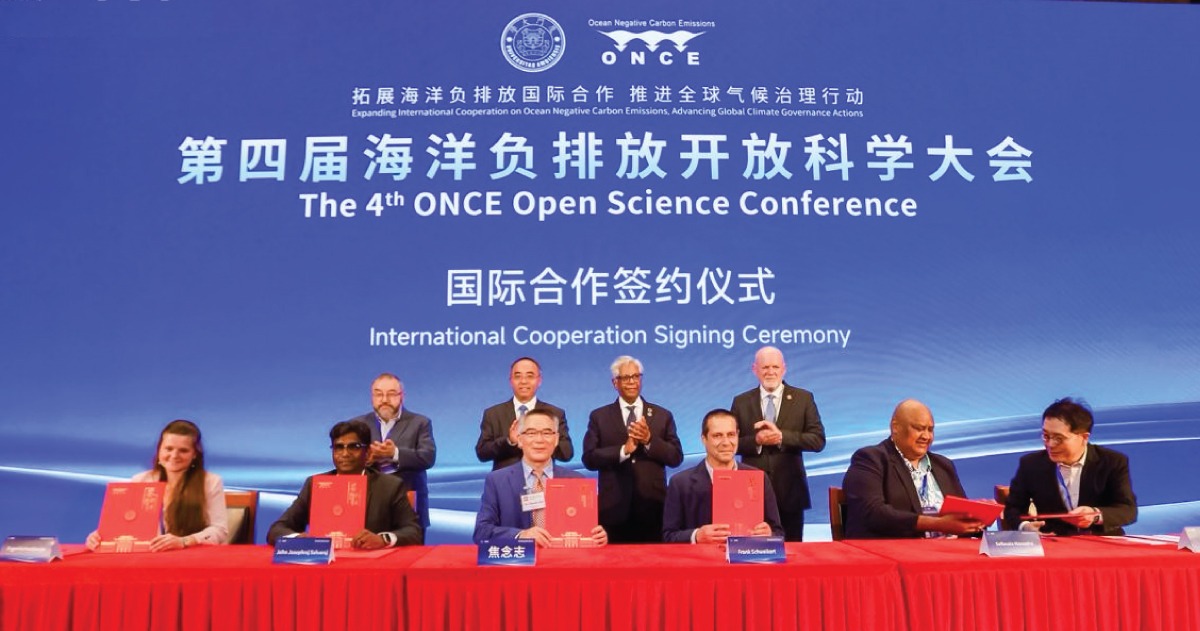
Science advances when knowledge, capabilities and shared commitment come together. With this vision, CEMarin has signed a Memorandum of Understanding (MoU) with Global Ocean Negative Carbon Emissions (Global ONCE), China, to promote international cooperation on climate change and marine ecosystem health, within the framework of the United Nations Decade of Ocean Science for Sustainable Development.
Global ONCE is an international research programme endorsed by the United Nations Decade of Ocean Science for Sustainable Development since 2022. It is led by Professor Nianzhi Jiao, a member of the Chinese Academy of Sciences, professor at Xiamen University and the programme’s chief scientist. Today, the network brings together more than 100 institutions from over 30 countries, working to develop ocean-based solutions for carbon sequestration and climate change mitigation.
As part of this partnership, CEMarin will lead the Colombian node of the South American cooperation plan, focusing on coral reef restoration in the Archipelago of San Andrés, Providencia and Santa Catalina, and blue carbon in mangroves along Colombia’s Pacific coast. This partnership offers an opportunity to expand our network’s international connections and explore synergies between the scientific expertise of our 10 member institutions and that of researchers and organisations affiliated with Global ONCE.
What opportunities does this partnership offer CEMarin researchers?
The memorandum establishes a framework for cooperation that encompasses several opportunities to strengthen scientific and academic collaboration between Colombia and China:
- Collaborative research: Explore joint projects on climate change, marine ecosystem health and ocean-based climate solutions.
- Researcher and academic exchange: Connect research groups, professors and specialists to share experiences, knowledge and expertise.
- Academic training and mobility: Explore programmes for students and professors, including short- and long-term research stays and academic exchanges.
- New cooperation frameworks: Identify opportunities to develop collaborative mechanisms and even potential joint research centres.
- Shared resources and knowledge: Facilitate the exchange of academic resources and the development of scientific initiatives of mutual interest.
Have an idea? CEMarin wants to connect your expertise with new opportunities.
This cooperation does not begin and end with the signing of a document. We want it to be the starting point for building new opportunities together with the people who are part of our network.
That is why we invite our researchers to explore these new international connections, identify shared research interests with China, and consider projects, research questions, academic initiatives or areas of expertise that could benefit from a strategic partner.
Do you have a research area that could be developed in collaboration with Chinese researchers? Can you identify an opportunity for academic exchange? Is there an initiative for which China could be a strategic partner?
We want to hear your ideas!
At CEMarin, we aim to serve as a bridge that connects expertise, identifies potential partners and facilitates collaboration, helping turn promising ideas into cooperation opportunities.
Working alongside Professor Chuanlun Zhang (SUSTech), our contact for international collaboration, we invite you to share your interests and proposals by emailing us at projects@cemarin.org. Our team will work to identify potential synergies and explore ways to take these initiatives forward through new collaborative opportunities.
Science knows no boundaries when we work together. Let us continue building new opportunities for Colombian marine research as a network.