
What’s happening with water in San Andrés, Providencia, and Santa Catalina?


The impacts of population growth and tourism are clearly reflected in the archipelago’s natural resources. As an oceanic island territory, its natural resources are limited. With the population growth that San Andrés Island has experienced to this day, along with an unexpected increase of 914,369 visitors per year by 2015, projections estimate that by 2040 there will be around 1,906,593 visitors annually. This would create a demand of 8,756,425 m³ of drinking water per year to meet the needs of both residents and tourists. Such demand could lead to water shortages, as it would exceed the supply capacity of the aquifers—the main source of water—which had a natural recharge between 7,303,852 m³ and 11,057,104 m³ per year as of 2016 (Guerrero, 2020).

Aggravating Factors


Climate change and rising temperatures

According to the Intergovernmental Panel on Climate Change (2022), Small Island Developing States and similar territories like San Andrés are highly vulnerable to events such as stronger tropical cyclones, more intense and variable rainfall and droughts, coral bleaching, and rising sea levels.


What does this mean?

Greater intrusion of seawater into the island’s aquifers, making it harder to purify and supply drinking water.

Changes in the hydrological regime may also lead to more frequent extreme events, such as hurricanes, increasing the island’s risk and vulnerability when it comes to meeting both current and future water needs.


Is there a solution?

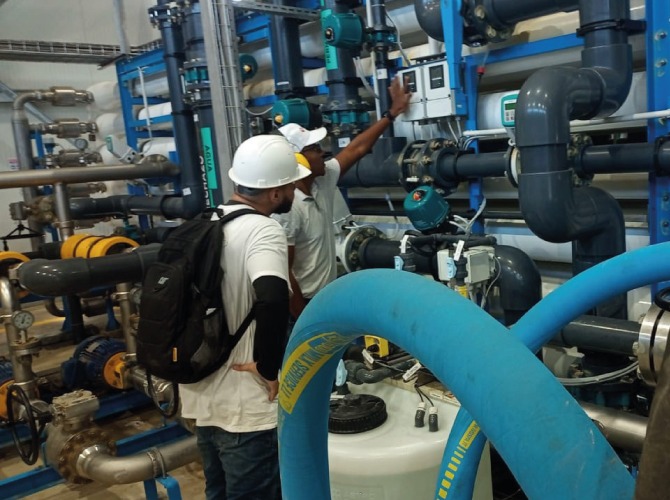
Desalination is a process in which, through different filtering techniques, membrane technology, and applied pressure, the mineral components of seawater are separated to produce permeate water. This water is then remineralized to make it safe for human consumption.

However, the process generates brine as a byproduct— a highly saline effluent containing traces of various minerals, metals, and complex chemical compounds that can harm marine flora and fauna.

A pilot desalination plant is planned for Johnny Cay islet, using Salinity Gradient Energy (SGE) technology. This innovation would serve as a first step toward decarbonizing the way seawater is desalinated.

What are we aiming for with this project?

The main goal of the project is to harness the potential of seawater by developing a prototype that combines alternative energy production with a seawater desalination system on San Andrés Island. In the long term, this prototype is expected to serve as a model that can be replicated for the installation of similar systems elsewhere.


Specific Objectives

1.Implement an integrated monitoring system for oceanographic, climatic, and hydrogeological variables to assess their relationship with land–sea environmental impacts associated with the desalination process.

2.Develop a prototype of non-conventional energy production coupled with a seawater desalination system, with a sustainable approach.

3.Evaluate the performance of the non-conventional energy production system coupled with desalination, and carry out a technical and financial assessment to scale the system for future applications.

Environmental Monitoring

Importance and Physicochemical Variables


Responsible environmental management and informed decision-making require continuous and detailed monitoring of variables such as salinity, temperature, and concentrations of heavy metals in seawater. This provides essential input for:

To Ensure

To ensure a complete and detailed spatio-temporal record is essential. Physicochemical measurements of water must be complemented with measurements of the drivers of these processes, which include hydrodynamic variables such as waves, tides, and currents, as well as meteorological variables like atmospheric pressure, wind speed and direction, and solar radiation, among others.

To Provide

To gain a comprehensive understanding of the physical phenomenon under study, it is essential to carry out an integrated analysis of these data. This approach facilitates the detection of potential contamination areas and the assessment of their impacts on marine ecosystems. At the same time, it makes it possible to evaluate the extent of adverse effects and to develop mitigation strategies.

To Understand

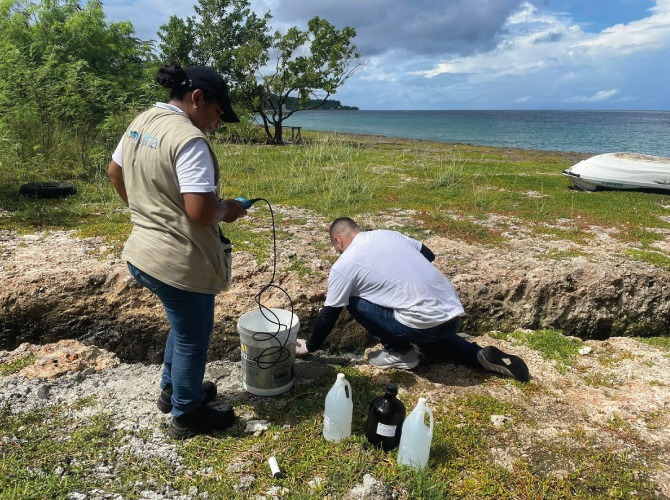
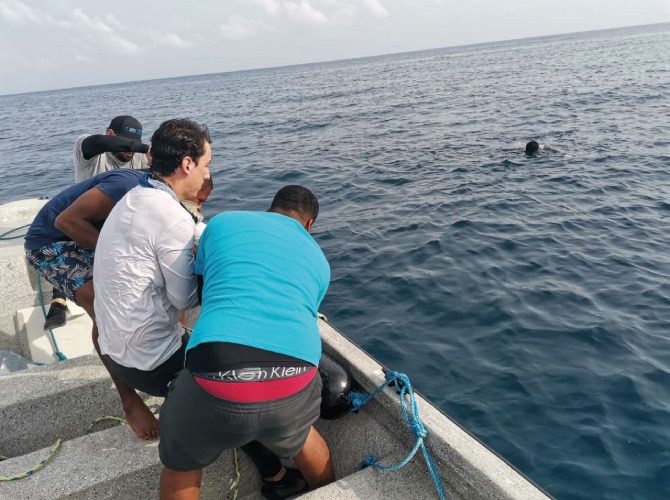
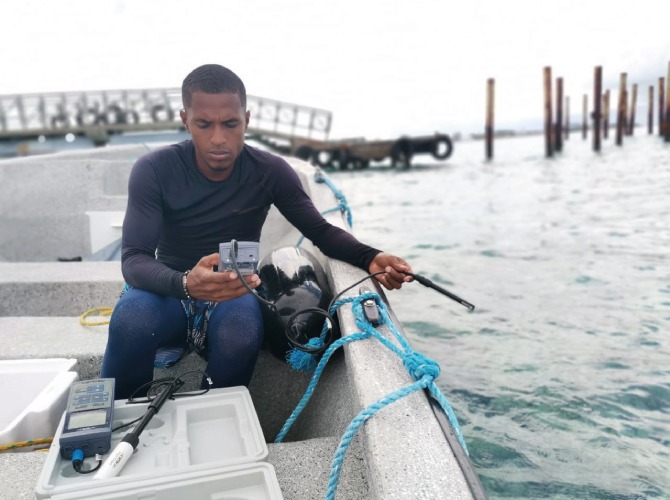
To determine the extent of brine dispersion in the coastal marine zone, measurements of salinity and temperature profiles have been carried out, along with the assessment of potential heavy metals present in the brine. At the same time, it is essential to complement these records with measurements of hydrodynamic variables.

Together with CORALINA, three field campaigns were carried out between 2023 and 2024 with the aim of building local capacity to ensure continuity in the monitoring and long-term follow-up of the variables under study.

Different water quality parameters were measured in order to establish a baseline for the western zone of Johnny Cay islet, where the pilot plant is planned to be installed.

Technological Challenges

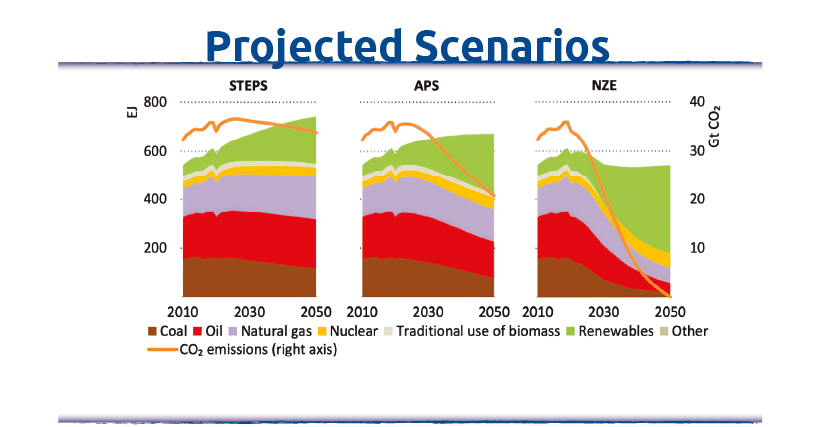
Among the global initiatives to tackle climate change, one of the most prominent is the strategy known as Net-Zero Emissions by 2050 (NZE), which sets out the main guidelines for achieving net-zero greenhouse gas (GHG) emissions worldwide by 2050, including within the energy sector [1, 2].

This optimistic scenario (NZE) has been widely promoted, and many governments, including Colombia’s, have committed to it. However, it is also important to consider a medium or more realistic scenario known as the Announced Pledges Scenario (APS), which reflects the implementation of all publicly announced commitments related to climate change mitigation, GHG emission reductions, technological development, and renewable energy deployment [2]. The third, more pessimistic scenario refers to current and ongoing public policies, known as the Stated Policies Scenario (STEPS) [2].

Figure 1. Pessimistic (STEPS), realistic (APS), and optimistic (NZE) scenarios

of energy production from different sources and their impact on net CO₂ emissions.

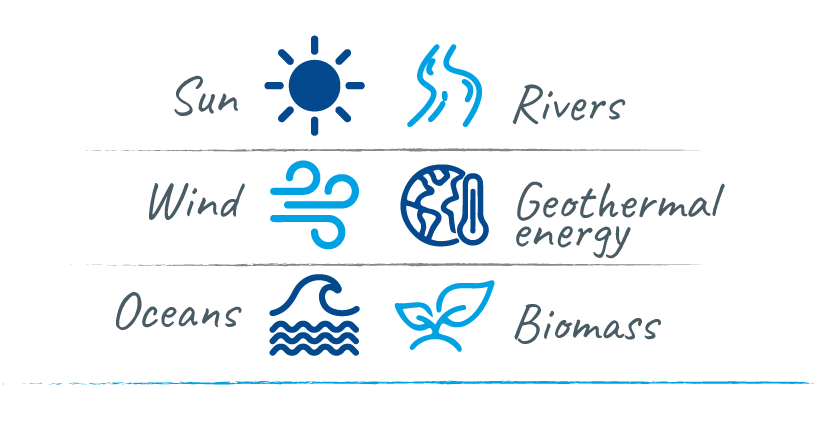
What are renewable energies?


In situations of excess energy production that cannot be directly used, or when storage beyond conventional batteries is required, hydrogen (H₂) emerges as a solution. This molecule has great potential as an energy carrier [4–7], since it can store energy that can later be released in a controlled manner without generating GHG emissions.

One of the most common methods of producing hydrogen is by splitting water molecules to obtain this gas and oxygen through electrolysis. This process requires a certain amount of energy, which, when sourced from surplus renewable energy generation, makes it possible to produce what is known as green hydrogen [8, 9]. This type of hydrogen can be produced from seawater or from desalinated water generated in a desalination plant powered by solar energy.

Thus, with the implementation of a solar-powered desalination plant in San Andrés Islands, all the necessary elements for its production are in place.

Figire 2.Different sources of conventional energy, organized by potential.

San Andrés must develop alternative business models that ensure environmental sustainability, foster full socio-cultural development, and support a stable long-term economy.


The island should be positioned as a tourist destination that promotes the preservation of the environment and local culture, offering activities such as ecotourism, hiking, diving, and the promotion of traditional cuisine.