
30 Sep Ecosystem at Risk: How the Loss of the Hydrological Regime Opened the Door to Hydrilla verticillata
The Ciénaga Grande de Santa Marta (CGSM) is one of the most productive coastal ecosystems in the world and the largest coastal wetland in Colombia. On September 24, I had the opportunity to visit the two largest stilt villages of the CGSM, Buenavista and El Morro (Nueva Venecia), accompanied by representatives of local communities and Jhon Cantillo, environmental leader and local liaison for the NGO Tras la Perla. In these settlements, Eichhornia crassipes(popularly known as water hyacinth) is a common aquatic plant. Although troublesome, it is usually relatively easy to control, since it tends to float and not take root.
Since late 2024, a new aquatic plant has been observed, apparently arriving through the Aguas Negras channel from the Magdalena River, and spreading rapidly since January of this year: Hydrilla verticillata (known locally as rabo de caballo, tornillo de agua, or lama). This rooted submerged species has expanded quickly. According to estimates from the Magdalena environmental authority, CORPAMAG, by May it already covered some 700 hectares. Today, it is likely that at least half of the Ciénaga de Pajaral has been colonized, occupying perhaps eight to ten times more area than just four months ago. From a distance, the water of the Ciénaga shows a greenish tone, but while navigating one can see the dense vegetal mesh covering the bottom. In Buenavista, it has also been detected, though in smaller proportions so far.
It’s as if the water hyacinth had been waiting for its cousin...
Jhon Cantillo remarked: finally, Eichhornia has someone to latch onto and cling with at the bottom of the lagoon complex.
As we approached El Morro, it became clear what he meant: Eichhornia on the surface intertwined with Hydrilla underwater form an impenetrable vegetal belt hundreds of meters wide around the village. Without a boat guided by local knowledge, it would have been very difficult to find the entrance channel.
For the inhabitants, the consequences are already tangible: fishing has become nearly impossible, navigation more difficult and even dangerous for outboard motor propellers.

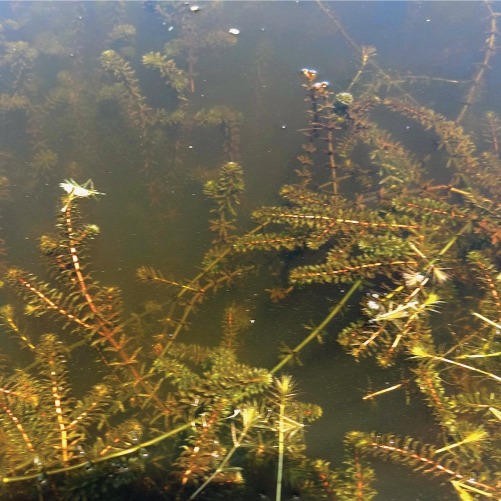
Photos: Fundación Tras la Perla / Horst Salzwedel
How did this get here? And how do we get back to normal?
I asked the communities. Everyone agreed on the same point: the water has become too fresh over many years; it must regain some salinity. It is imperative to restore the connections to the sea (box culverts) and dredge the silted Boca de la Barra to increase saltwater inflow and improve water circulation. Salinity data at the Aguas Negras station confirm what the community says: since 2020 it has remained below 10 psu, the maximum salinity tolerable for Eichhornia and Hydrilla. (Invemar 2024, Fig. 4.2-2a).
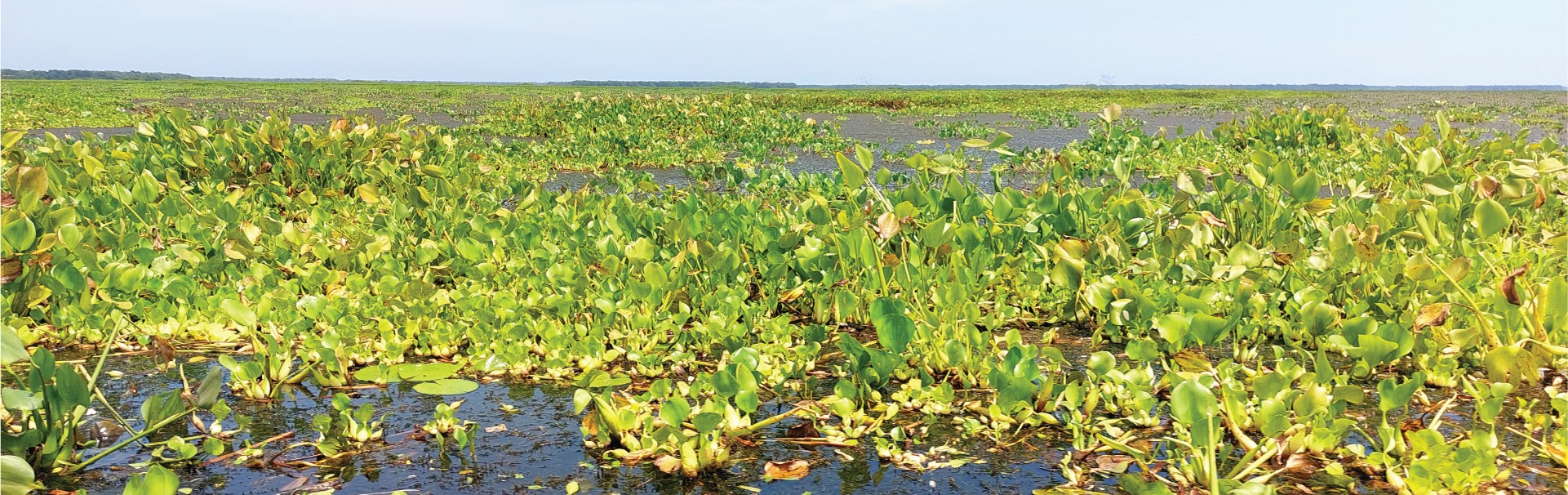
Foto: Horst Salzwedel
Since the time of the Pro-Ciénaga program (1992–2001), the major German-Colombian project for the rehabilitation of the Ciénaga Grande, it has been well known that the key to this brackish ecosystem is its balanced hydrological regime. No further studies (see Sí-CGSM) or roundtables are needed: what is required is for the Ministry of Environment to finally enforce the management plan pending for over 20 years; for INVEMAR to fulfill its monitoring role and issue timely alerts; and for CORPAMAG to use the 8% environmental surcharge levied on every vehicle traveling the Ciénaga–Barranquilla road for its intended purpose: the proper and timely maintenance of hydraulic works.
Acknowledgements: With special thanks to Fundación Tras la Perla for facilitating transportation during this visit. For more on their projects, see: Habitat Cumbiana – Tras la Perla.
Written by:
Horst Salzwedel.
Independent consultant, Santa Marta, Colombia.
CEMarin Associated Researcher.